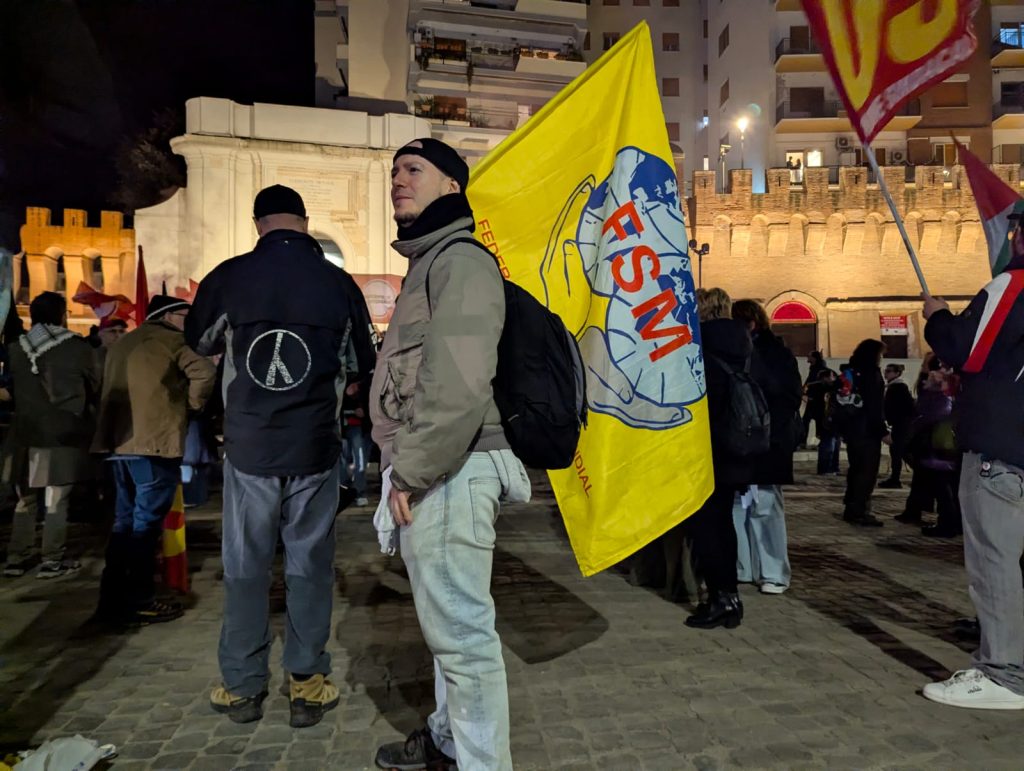


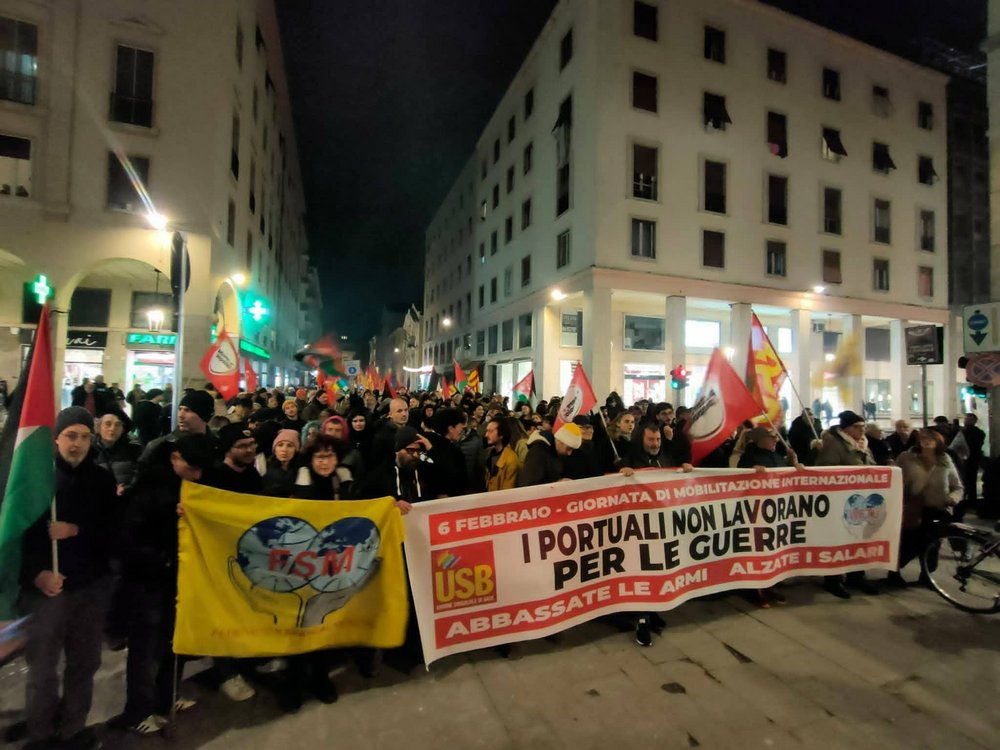
Friday the 6th saw five trade union organizations call a joint day of struggle, with demonstrations in the main European and Italian ports.
The strong international impact of the first international day of struggle by European and Mediterranean ports has confirmed how right it was to make the fight against war and the war economy one of the central issues for the future in Italy, in Europe, and in the world.
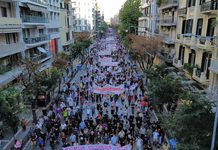
This was also confirmed by the participation of tens of thousands of workers, along with citizens, students, and industrial workers—in the various demonstrations held across different ports: in Piraeus, Elefsina, Bilbao, Pasaia, Mersin, and also in Marseille, Bremen, and Hamburg, as well as in 12 Italian cities.
Among the immediate results achieved by the mobilization, which blocked five ships, including three belonging to the Israeli company Zim and two from MSC bound for Israel, was the demonstration that workers can stop the chains of war logistics.
We express our closeness to the dockworkers and citizens of Morocco affected by the severe floods that led to the closure of ports and made it impossible to carry out any initiative.
We thank all those associations and movements that chose to support this day and were present at the demonstrations, such as BDS, GMTG, Thousand Madleen, Palestinian movements, and many others.
We chose to place at the center the role that work and workers can play in refusing to be complicit in this infernal mechanism and in stopping the militarist drift of our continent.
A choice that places international solidarity as a concrete and real tool to oppose imperialism, genocides, and aggressions, but also as an essential factor in defending wages, working conditions, health and safety, and the right to a pension for dockworkers.
Therefore, strengthened by what was done yesterday, starting today this path will continue toward strengthening solidarity, toward another day of struggle that will be even more widely attended, involving more ports and more workers, including from other sectors.
February 6 represents an important starting point, because it brings a fundamental issue to the table of international trade unionism: the rejection of the war economy, the rearmament plan, and the militarization of ports, while other demands also emerge strongly: the rejection of privatizations, higher wages, better pensions, and more adequate safety conditions for workers.